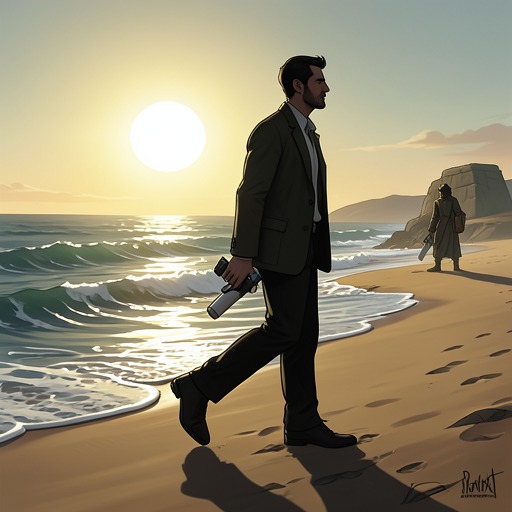
Revolver
The Stranger (Albert Camus Edition)The Revolver is Raymond Sintès’s weapon and the decisive object in the beach sequence that leads to Meursault’s killing of the Arab. Initially carried as part of Raymond’s readiness for renewed violence, it is handed to Meursault during a tense confrontation and later fired five times. The weapon therefore links Raymond’s private revenge to Meursault’s public prosecution, while its material presence makes an apparently unstable chain of choices look, in court, like a coherent plan.
Ownership and Transfer
Raymond brings the Revolver into the conflict created by his assault on his mistress and the resulting grudge held by the two Arabs. After Raymond and Masson attack the men on the beach, one Arab produces a Knife and slashes Raymond. The immediate danger recedes when the Arabs disappear beneath the cover of a rock, and Raymond returns toward the bungalow in a happier mood, talking about the bus for the journey back. The weapon remains part of the scene even after the first fight appears to be over.
At the stream, Raymond puts his hand to the Revolver pocket while the two Arabs remain still. He asks Meursault whether he should shoot his opponent. Meursault understands that directly urging restraint might provoke Raymond, so he initially responds cautiously, telling him that firing would have no justification unless the Arab drew his Knife. He then proposes a division of responsibility: Raymond should confront the fellow on the right, while Meursault should hold the Revolver and shoot only if the other man caused trouble or drew his Knife. Raymond accepts this arrangement and hands the weapon to Meursault.
The transfer changes the weapon’s position in the narrative. It is no longer merely Raymond’s hidden instrument of retaliation; it becomes an object physically held by Meursault, who is now responsible for deciding whether it will be used. The sun glints on the gun as it changes hands, while no one moves and the men watch one another across the narrow strip of sand. The moment suspends action rather than completing it: the weapon creates a possibility, but the possibility seems at first to have no necessary outcome. When the Arabs finally slip away, Meursault returns the situation to apparent normality by walking back with Raymond.
The Beach Shooting
The Revolver becomes decisive only after Meursault turns back toward the rock alone. He encounters Raymond’s Arab lying beneath the rock, partly shaded while the sun beats upon the rest of his body. The Arab’s hand moves toward his pocket, and Meursault grips the Revolver inside his coat. Although the distance between them is about ten yards, the heat haze repeatedly reduces the Arab to a blurred dark shape, making the weapon both a source of protection and a focus of attention.
Meursault considers walking away, but the oppressive heat, the remembered bodily sensations associated with his mother’s funeral, and the Arab’s Knife draw the encounter toward violence. When the Arab raises the blade, sunlight flashes from its steel and overwhelms Meursault’s sight. The weapon is experienced through the body before it is explained through intention: the heat, sweat, glare, and pressure of the moment culminate in Meursault’s grip closing around the Revolver and the trigger giving way.
Meursault fires once, then fires four more shots into the inert body. The repeated shots are crucial because they convert the Revolver from an instrument of immediate reaction into the visible sign of an act the prosecution can describe as completed deliberately. Meursault himself recognizes that the first shot has shattered the balance of the day and the calm of the beach; each further shot becomes a separate, fateful continuation of the act. The object thus participates in a value shift from suspended possibility to irreversible death, and from bodily confusion to legal consequence.
Evidence and Legal Meaning
After the arrest, the Revolver is absorbed into the court’s reconstruction of events. The Prosecutor argues that Meursault had written the letter with Raymond in order to lure Raymond’s mistress to his room, participated in the beach brawl, asked Raymond for the weapon, and then returned alone with the intention of using it. In this account, the Revolver supplies the prosecution with a bridge between the earlier conflict and the killing: its transfer is presented not as a contingent response but as a deliberate step in a premeditated sequence.
The prosecution emphasizes that Meursault waited after the first shot and then fired four additional shots at close range. This arrangement of the weapon’s use allows the Prosecutor to reject the idea of a sudden impulse or an act committed without awareness. The Revolver becomes more than physical evidence; it is made to testify to an alleged criminal mentality. Its presence lets the court organize ambiguous circumstances into a straight line running from Raymond’s grievance to Meursault’s supposed intention and finally to the dead man.
Raymond’s testimony attempts to interrupt that interpretation. He tells the court that the grudge belonged to him because he had beaten up the Arab’s sister, that Meursault’s presence on the beach was a coincidence, and that the letter’s role was also due to chance. These claims do not erase the fact that Raymond owned the Revolver or that Meursault held it, but they contest the prosecution’s effort to make the weapon prove a complete design. The same object can therefore be read in two incompatible ways: as the instrument of a calculated plan or as one element in a chain of accidents, pressures, and improvised decisions.
Material Agency and Narrative Significance
The Revolver’s force lies partly in its physical conspicuousness. While it is in Raymond’s pocket, it remains a concealed threat; once Raymond hands it over, the sun catches its surface and the weapon becomes impossible to treat as an abstract possibility. Meursault’s hand, the coat pocket, the trigger, and the body of the Arab form a material sequence in which human intention is never entirely separate from heat, glare, distance, and the Knife. The object does not act independently, but it changes what actions are available and what consequences can follow from them.
Its narrative function also depends on absence and recurrence. The Revolver disappears from immediate use when the Arabs retreat, yet Meursault continues to carry it back toward the beach. Its return to the scene makes the earlier confrontation active again, even though Meursault had believed the incident closed. Once fired, it cannot be reduced to the single instant of the first shot: the four additional shots give the object a repeated rhythm that later governs the court’s moral interpretation.
Finally, the Revolver binds together Raymond’s violence, Meursault’s vulnerability to circumstance, and the legal system’s appetite for motive. Raymond introduces it as part of a personal feud; Meursault accepts it as a precaution; the Arab’s Knife and the sun become immediate pressures; and the Prosecutor later turns the gun into proof of conscious intent. Its decisive significance is therefore not simply that it kills the Arab. The Revolver makes responsibility transferable, makes chance appear like design, and gives the court a tangible object around which it can construct the story of Meursault’s guilt.